EcoGeneration
www.EcoGeneration.com

EcoGeneration - by EcoGeneration Solutions


EcoGeneration Solutions: Products, Services & Solutions

Biomass Gasification  Carbon Emissions  Carbon Free Energy  *  Clean Power Generation 

Cogeneration  Demand Side Management  *  Emissions Abatement  *  Emissions Abatement

Emissions Engineering  Engineering Feasibility  Front End Engineering Design  Engineering Feasibility

Hazardous Air Pollutants  *  Methane Recovery  Net Zero Energy  *  Pollution Free Power  Recycled Energy 

Engineering Feasibility  Selective Catalytic Reduction  Sewage Sludge  Solar Cogeneration  *  Trigeneration 

Volatile Organic Compounds  Waste Heat Recovery  Waste to Energy  *  Waste to Fuel


For more information, call/email:
EcoGeneration Solutions

info@EcoGeneration.com


__________________________________________________

EcoGeneration
www.EcoGeneration.com

What is EcoGeneration?
"EcoGeneration" is the term we created in 1999 to describe the economic and ecological benefits and advantages of;

and a number of other "renewable energy technologies."

The ecological and economic benefits we provide our clients translates directly into huge savings for our ecology by significantly reducing, and sometimes eliminating the pollution typically associated with power generation. The economic benefits our customers enjoy include saving as much as 90% of the costs they once spent for fuel, the public relations advantages that go hand-in-hand with EcoGeneration as well as the benefit of being viewed as a "good neighbor" by the communities they are located in. 

EcoGeneration also seeks to minimize the "waste-heat" that is also present in the generation of power and energy in about 500,000 smoke stacks found at power plants and other facilities that have turbines and engines.  Other sources of waste heat include; furnaces, boilers and chimney-stacks.  We provide engineering services relating to waste heat recovery and assist our clients convert the waste-heat into other useful energy products such as electricity, hot water, steam and chilled water.  We call this "recycled energy." 

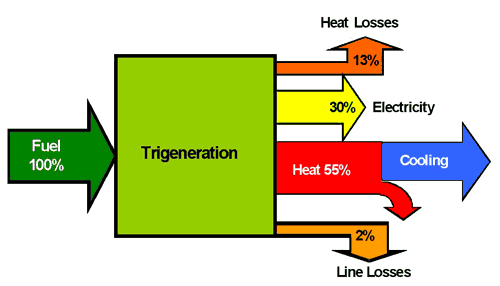
Depending on our clients' requirements, we may implement energy solutions that include technologies such as; cogeneration/combined-cycle, trigeneration, quadgeneration, absorption/adsorption chillers, hydrogen fuel cells, solar, geothermal and "waste to energy" or "waste to fuel" fuels such as organic diesel/soybean diesel, digester gas or landfill gas. 

EcoGeneration provides not only ecological benefits, but also economic benefits, as we oftentimes reach and exceed system efficiencies of 90% - a dramatic increase over typical power plants that remain at only 27% - 33% efficient. What this means to our customers is they save huge amounts of money in the form of fuel savings, because the "waste-heat" we recover, is no longer wasted, since we are able to convert that waste-heat into the useful energy they need (hot water, steam and chilled water).

We provide "EcoGeneration™" solutions that produce "cooler, cleaner, greener power and optimized power and energy systems. "EcoGeneration™" is the term we coined that means "clean, green power that is renewable and "sustainable." As opposed to hydrocarbon-based fuels, such as oil, natural gas, coal, propane, etc., EcoGeneration™sources of power and energy include; all renewable fuels or Biofuels such as Biomethane, Biodiesel, Ethanol, Geothermal, (but NOT geothermal when connected to the grid) and Hydrogen, as well as power and energy generated by the wind, the sun (solar) and water (hydro and ocean), and also biofuel-fired cogeneration, trigeneration and quadgeneration, waste-to-energy and distributed generation or onsite power generation when using a biofuel/bioenergy supplied source of power or energy.

Unlike most companies, we are equipment supplier/vendor neutral. This means we help our clients select the best equipment for their specific application. This approach provides our customers with superior performance, decreased operating expenses and increased return on investment. 

EcoGeneration Solutions provides the following, some in affiliation with our engineering / EPC companies: 

__________________________________________________


GreatSkin.com


____________________________________________________

EcoGeneration Solutions include;
Anaerobic Digesters
Architectural
Battery Energy Storage
Biogas
Biomass Gasification
B100 Biodiesel
Biomethane
Carbon Free Energy
CNG - Compressed Natural Gas (when using Biomethane or Synthesis Gas)
CPV - Concentrated Photovoltaic
CSP - Concentrating Solar Power
Cogeneration
Decentralized Energy
Demand Side Management
Dispersed Generation
Distributed Generation
Distributed PV
Distributed Solar Generation
E100 Ethanol (sugar cane & sugar beet)
EcoGeneration
Emissions Abatement
Emissions Engineering
Emissions Reductions
Energy Conservation Measure
Energy Efficiency Measures
Energy Efficient Lighting
Energy Master Planning
Evacuated Tube Collectors
Flywheel Energy Storage
Front End Engineering Design - FEED
Geothermal 
HCPV - High Concentration Photovoltaic
Hydrogen Fuel
Hydrogen Fuel Cells
Net Zero Energy
Plasma Gasification
Renewable Energy Technologies
Renewable Fuel
Rooftop PV
Solar 
Solar Cogeneration
Solar Energy Systems
Solar PV 
Solar Trigeneration
Stranded Gas
Sustainable Urban Living
Synthesis Gas
Trigeneration
Vertical Axis Wind Turbine
Waste Heat Recovery
Waste to Energy
Waste to Fuel
Wind

What is Emissions Engineering?

Emissions engineering is an engineering field that seeks to identify and reduce or eliminate environmental pollutants and emissions that are either hazardous, toxic or contribute to a wide range oh health or environmental problems.

Examples of emissions that are in the emissions engineering industry include;

EcoGeneration Solutions provides emissions engineering services - some with assistance from our engineering partner companies.


What Are
Hazardous Air Pollutants? 


Hazardous Air Pollutants or "HAPs" are generally defined as those pollutants that are known or suspected to cause serious health problems. Section 112(b) of the Clean Air Act currently identifies a list of 188 pollutants as HAPs. EPA's ATW Web site presents more information on HAPs, their effects, and EPA's programs to reduce HAPs.


What Sources Emit
Hazardous Air Pollutants?

Hazardous Air Pollutants are emitted by a variety of source categories that include stationary major and area sources, other stationary sources, and mobile sources. Major and area source categories are defined in Section 112 of the Clean Air Act.

Major sources are large stationary sources that emit more than 10 tons per year of any listed
Hazardous Air Pollutant or a combination of listed HAPs of 25 tons per year or more. The NTI includes facility data for major sources. Examples of major sources include electric utility plants, chemical plants, steel mills, oil refineries, and hazardous waste incinerators. These sources may release air toxics from equipment leaks, when materials are transferred from one location to another, or during discharge through emissions stacks or vents. 

Area sources are smaller stationary sources that emit less than 10 tons per year of a single
Hazardous Air Pollutant or less than 25 tons per year of a combination of air toxics. The NTI includes facility data for some area sources and aggregated emission estimates at the county level for the remaining area sources. Area sources are regulated under toxics provisions in the Clean Air Act. Examples of area sources include neighborhood dry cleaners and gas stations. Though emissions from individual area sources are often relatively small, collectively their emissions can be of concern particularly where large numbers of sources are located in heavily populated areas. 

Other stationary sources are sources that may be more appropriately addressed by other programs rather than through regulations developed under certain air toxics provisions (sections 112 or 129) in the Clean Air Act. Examples of other stationary sources include wildfires and prescribed burning whose emissions are being addressed through the burning policy agreed to by EPA and USDA. 

Mobile source categories include on-road vehicles, non-road 2- and 4- stroke and diesel engines, off road vehicles, aircraft, locomotives, and commercial marine vessels. 


What are 
Volatile Organic Compounds?

Volatile organic compounds (VOCs) are emitted as gases from certain solids or liquids. Volatile organic compounds include a variety of chemicals, some of which may have short- and long-term adverse health effects. Concentrations of many Volatile organic compounds are consistently higher indoors (up to ten times higher) than outdoors.  


Where do
Volatile Organic Compounds Come From?

Volatile organic compounds are emitted by a wide array of products numbering in the thousands. Examples include: paints and lacquers, paint strippers, cleaning supplies, pesticides, building materials and furnishings, office equipment such as copiers and printers, correction fluids and carbonless copy paper, graphics and craft materials including glues and adhesives, permanent markers, and photographic solutions. Volatile organic compounds are found in everything from paints and coatings to cleaning fluids. 

Key signs or symptoms associated with exposure to Volatile organic compounds include conjunctival irritation, nose and throat discomfort, headache, allergic skin reaction, dyspnea, declines in serum cholinesterase levels, nausea, emesis, epistaxis, fatigue, dizziness.

What are the Health and Environmental Implications from
Volatile Organic Compounds?

The U.S. Environmental Protection Agency (EPA) is very concerned over the release of VOCs into our environment as are each of the state's air quality boards across the United States.
Volatile organic compounds are significant contributing factor to the production of ozone, a major air pollutant in large metropolitan cities, which are proven to be a public health hazard.

Ozone protects the earth and the environment when it is located in the upper atmosphere by reflecting the sun's ultraviolet rays. However, when ozone is produced and found at ground-level, it then becomes a major pollutant and causes harm to all life forms.  

According the the EPA, ozone is a highly reactive gas that "negatively affects the normal function of the lung in many healthy humans." EPA's studies show that breathing air with ozone concentrations above air quality standards aggravates symptoms of people with pulmonary diseases and seems to increase rates of asthma attacks. 

Prolonged exposure to ozone causes permanent damage to lung tissue and interferes with the functioning of the immune system. Ozone has been difficult to control because it is not emitted into the air, but formed in the atmosphere through a photochemical process.
Volatile organic compounds play a large role in the photochemical process and production of ozone as they react in the air with nitrogen oxides and sunlight to form ozone. Because of this, the EPA has determined that controlling VOCs is an effective method for minimizing ozone levels.

How We Assist Our Customers Turn an Environmental Problem and Expenses Into Profits

We recover Volatile Organic Compounds (VOC) and convert the "waste" into fuel for use by the company generating the VOCs. 

Instead of an expense cost for incinerating the "waste" in a thermal oxidizer, we create clean energy from the recovered
Volatile organic compounds, and decrease the facility's energy costs  

Our VOC Control technology permits our client companies to meet even the most stringent European environmental laws and legislation. These ever- increasingly greater environmental laws to control VOCs in Europe and the U.S. has caused companies to become tougher on measuring and controlling volatile organic compounds. Our VOC Control  solutions exceed all environmental requirements and reduce your energy and environmental expenses and costs, creating profits for your company from what was an expense. 

What is a Certified Emission Reduction?

A Certified Emission Reduction (CERs) is the technical term for the output of Clean Development Mechanism (CDM) projects, as defined by the Kyoto Protocol. A unit of Greenhouse Gas reductions that has been generated and certified under the provisions of Article 12 of the Kyoto Protocol,  the Clean Development Mechanism (CDM). 

In contrast, Emission Reduction Credits (ERCs) are used for Joint Implementation (JI) under Article 6 of the Protocol. According to Article 12, Certified Emission Reductions must be "certified by operational entities to be designated by the Conference of the Parties (COP) serving as the Meeting of the Parties (MOP)."


What is an Emission Reduction Credit?

An Emission Reduction Credit (ERC) is a credit granted upon request by an emission source who voluntarily reduces emissions beyond required levels of control. An Emission Reduction Credit represents the legal ability to emit regulated pollutants in an amount equal to the quantity specified when the Emission Reduction Credit was granted. 

Emission Reduction Credits may be sold, leased, banked for future use, or traded in accordance with applicable regulations established by SWCAA. 

Emission Reduction Credits are intended to provide an incentive for reducing emissions below required levels, and to establish a framework to promote a market based approach to air pollution control.


What are Greenhouse Gas Emissions?

Greenhouse Gas Emissions are those greenhouse gases that allow sunlight to enter the atmosphere freely and contribute to the greenhouse effect, which many believe is the cause of global warming. There are natural and man-made greenhouse gas emissions.  The primary greenhouse gases thought to be major contributors to global warming are; carbon dioxide emissions (CO2), methane emissions (CH 4) and nitrogen oxides (N2O). 

The primary sources of greenhouse gas emissions from manmade sources include; fossil-fueled power plants such as natural gas power plants and coal fired power plants. Other sources of greenhouse gas emissions linked to manmade causes include  internal combustion engines (fueled by gasoline and petroleum diesel) and deforestation.

Many people don't realize that as much as 25% of  per cent of the carbon dioxide emissions are naturally absorbed by the ocean and another 25% of the carbon dioxide emissions are absorbed by our biosphere, such as trees, plants, soil, etc.  This leaves about 50% of the carbon dioxide emissions that are not absorbed and remaining in our atmosphere. As previously stated, carbon dioxide emissions are linked primarily to the burning of fossil fuels (power plants, cars, trucks, etc.) and deforestation.

Greenhouse gas emissions have been on the increase ever since the dawn of the industrial revolution.


What Are Greenhouse Gases?

Many chemical compounds found in the Earth’s atmosphere act as “greenhouse gases.” These gases allow sunlight to enter the atmosphere freely. When sunlight strikes the Earth’s surface, some of it is reflected back towards space as infrared radiation (heat). Greenhouse gases absorb this infrared radiation and trap the heat in the atmosphere. Over time, the amount of energy sent from the sun to the Earth’s surface should be about the same as the amount of energy radiated back into space, leaving the temperature of the Earth’s surface roughly constant.

Many gases exhibit these “greenhouse” properties. Some of them occur in nature (water vapor, carbon dioxide, methane, and nitrous oxide), while others are exclusively human-made (like gases used for aerosols).


What are Carbon Dioxide Emissions?

According to the EPA, Carbon Dioxide Emissions, or "Carbon Emissions" or simply "CO2," are generated in a number of ways. Carbon Dioxide Emissions are produced naturally through the carbon cycle and through human activities like the burning of fossil fuels.

Natural sources of CO2 occur within the carbon cycle where billions of tons of atmospheric CO2 are removed from the atmosphere by oceans and growing plants, also known as ‘sinks,’ and are emitted back into the atmosphere annually through natural processes also known as ‘sources.’ When in balance, the total carbon dioxide emissions and removals from the entire carbon cycle are roughly equal.

Since the Industrial Revolution in the 1700’s, human activities, such as the burning of oil, coal and gas, and deforestation, have increased CO2 concentrations in the atmosphere. In 2005, global atmospheric
concentrations of CO2 were 35% higher than they were before the Industrial Revolution.

Carbon Dioxide Emissions are responsible for about 80% of the problems related to Greenhouse Gas Emissions

Carbon Dioxide Emissions and carbon dioxide are one of the six chemicals

and all six chemicals are planned to be significantly reduced via the global agreements under the Kyoto Protocol and new legislation in the U.S. under the pending "Cap and Trade" regulations in an effort to prevent climate change. 


How Can We Decrease Greenhouse Gas Emissions?

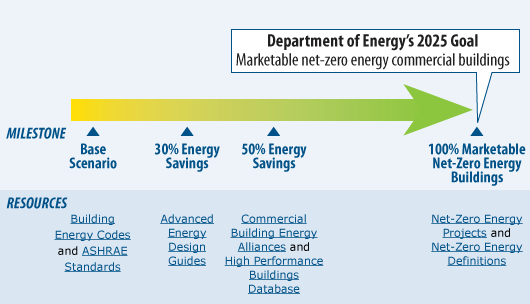
Greenhouse gas emissions can be reduced by switching from fossil fuels to renewable energy technologies, such as solar energy systems, and upgrading brown buildings to Net Zero Energy Buildings.


Why Are Atmospheric Levels of Greenhouse Gas Emissions Increasing?

Levels of several important greenhouse gases have increased by about 25 percent since large-scale industrialization began around 150 years ago (Figure 1). During the past 20 years, about three-quarters of human-made carbon dioxide emissions were from burning fossil fuels.

Figure 1. Trends in Atmospheric Concentrations and Anthropogenic Emissions of Carbon Dioxide

Figure 1 is a line graph showing the trends in atmospheric concentrations and anthropogenic emissions of carbon dioxide.


Concentrations of carbon dioxide in the atmosphere are naturally regulated by numerous processes collectively known as the “carbon cycle” (Figure 2). The movement (“flux”) of carbon between the atmosphere and the land and oceans is dominated by natural processes, such as plant photosynthesis. While these natural processes can absorb some of the net 6.1 billion metric tons of anthropogenic carbon dioxide emissions produced each year (measured in carbon equivalent terms), an estimated 3.2 billion metric tons is added to the atmosphere annually. The Earth’s positive imbalance between emissions and absorption results in the continuing growth in greenhouse gases in the atmosphere.

Figure 2. Global Carbon Cycle (Billion Metric Tons Carbon)

Figure 2 is a flow diagram showing the global carbon cycle.


What Effect Do Greenhouse Gas Emissions Have on Climate Change?

Given the natural variability of the Earth’s climate, it is difficult to determine the extent of change that humans cause. In computer-based models, rising concentrations of greenhouse gases generally produce an increase in the average temperature of the Earth. Rising temperatures may, in turn, produce changes in weather, sea levels, and land use patterns, commonly referred to as “climate change.”

Assessments generally suggest that the Earth’s climate has warmed over the past century and that human activity affecting the atmosphere is likely an important driving factor. A National Research Council study dated May 2001 stated, “Greenhouse gases are accumulating in Earth’s atmosphere as a result of human activities, causing surface air temperatures and sub-surface ocean temperatures to rise. Temperatures are, in fact, rising. The changes observed over the last several decades are likely mostly due to human activities, but we cannot rule out that some significant part of these changes is also a reflection of natural variability.”

However, there is uncertainty in how the climate system varies naturally and reacts to emissions of greenhouse gases. Making progress in reducing uncertainties in projections of future climate will require better awareness and understanding of the buildup of greenhouse gases in the atmosphere and the behavior of the climate system.


What Are the Sources of Greenhouse Gas Emissions?

In the U.S., our greenhouse gas emissions come mostly from energy use. These are driven largely by economic growth, fuel used for electricity generation, and weather patterns affecting heating and cooling needs. Energy-related carbon dioxide emissions, resulting from petroleum and natural gas, represent 82 percent of total U.S. human-made greenhouse gas emissions (Figure 3). The connection between energy use and carbon dioxide emissions is explored in the box on the reverse side (Figure 4).

Figure 3. U.S. Anthropogenic Greenhouse Gas Emissions by Gas, 2001 (Million Metric Tons of Carbon Equivalent)  

Figure 3 is a pie chart showing the anthropogenic greenhouse gas emissions in the U.S. by gas type.


Figure 4. U.S. Primary Energy Consumption and Carbon Dioxide Emissions, 2001

Figure 4 is a  charting of the U.S. primary energy consumption with the resulting carbon dioxide emissions. For more detailed information about this chart, please call the National Energy Information Center at (202)586-8800.


Another greenhouse gas, Biomethane, comes from landfills, coal mines, oil and gas operations, and agriculture; it represents 9 percent of total emissions. Nitrogen oxides (5 percent of total emissions), meanwhile, is emitted from burning fossil fuels and through the use of certain fertilizers and industrial processes. Human-made gases (2 percent of total emissions) are released as byproducts of industrial processes and through leakage.

What Is the Prospect for Future Carbon Dioxide Emissions?

World carbon dioxide emissions are expected to increase by 1.9 percent annually between 2001 and 2025 (Figure 5). Much of the increase in these emissions is expected to occur in the developing world where emerging economies, such as China and India, fuel economic development with fossil energy. Developing countries’ emissions are expected to grow above the world average at 2.7 percent annually between 2001 and 2025; and surpass emissions of industrialized countries near 2018.

Figure 5. World Carbon Dioxide Emissions by Region, 2001-2025
(Million Metric Tons of Carbon Equivalent)

Figure 5 is a line graph showing world carbon dioxide emissions by region from 2001-2025.

The U.S. produces about 25 percent of global carbon dioxide emissions from burning fossil fuels; primarily because our economy is the largest in the world and we meet 85 percent of our energy needs through burning fossil fuels. The U.S. is projected to lower its carbon intensity by 25 percent from 2001 to 2025, and remain below the world average (Figure 6).

Figure 6 is also a line graph showing carbon intensity by region from 2001-2025.

Figure 6. Carbon Intensity by Region, 2001-2025
(Metric Tons of Carbon Equivalent per Million $1997)

Energy Production and Carbon Dioxide Emissions

For over one hundred years, energy and power production have been generated around the world through the burning of fossil fuels, including;  fuel oil, coal, diesel, and natural gas.  Over the past decade, environmental science and research has discovered and linked global warming, and global climate change to the carbon dioxide emissions from the combustion of fossil fuels.  This has placed an increased need to reduce energy consumption and discover more environmentally friendly fuel sources.

__________________________________________________________________________________________________________________

What is "Decentralized Energy"?

Decentralized Energy is the opposite of "centralized energy."  Decentralized Energy energy generates the power and energy that a residential, commercial or industrial customer needs, onsite. Examples of decentralized energy production are solar energy systems and solar trigeneration energy systems.

Today's electric utility industry was "born" in the 1930's, when fossil fuel prices were cheap, and the cost of wheeling the electricity via transmission power lines, was also cheap.  "Central" power plants could be located hundreds of miles from the load centers, or cities, where the electricity was needed. These extreme inefficiencies and cheap fossil fuel prices have added a considerable economic and environmental burden to the consumers and the planet.

Centralized energy is found in the form of electric utility companies that generate power from "central" power plants. Central power plants are highly inefficient, averaging only 33% net system efficiency.  This means that the power coming to your home or business - including the line losses and transmission inefficiencies of moving the power - has lost 75% to as much as 80% energy it started with at the "central" power plant.  These losses and inefficiencies translate into significantly increased energy expenses by the residential and commercial consumers.


Decentralized Energy
is the Best Way to Generate Clean and Green Energy! 

How we make and distribute electricity is changing! 

The electric power generation, transmission and distribution system (the electric "grid") is changing and evolving from the electric grid of the 19th and 20th centuries, which was inefficient, highly-polluting, very expensive and “dumb.”  

The "old" way of generating and distributing energy resembles this slide:


The electric grid of the 21st century (see slide below) will be Decentralized, Smart, Efficient and provide "carbon free energy" and “pollution free power” to customers who remain on the electric grid.  The electric grid of the future will be comprised of both Onsite Power Generation plants and "utility scale power plants" that are fueled/powered with Biomass Gasification, Biomethane, Concentrating Solar Power, B100 Biodiesel, Distributed PV, EcoGeneration Systems, Geothermal Power Plants, Synthesis Gas, Rooftop PV, Solar Cogeneration, Solar Energy Systems, Solar Power Parks, Solar Trigeneration and Wind Power Generation  - located at Residential, Commercial, Industrial and City/Municipal Locations. 
Some customers will choose to dis-connect from the grid entirely.  (Electric grid represented by the small light blue circles in the slide below.)

The transmission grid will be upgraded to a "Transmission Superhighway" with green electrons now being wheeled via "High Voltage Direct Current."

Typical "central" power plants and the electric utility companies that own them will either be shut-down, closed or go out of business due to one or more of the following:  failed business model, inordinate expenses related to central power plants that are inefficient, excessive pollution/emissions, high costs, continued reliance on the use of fossil fuels to generate energy, and the failure to provide efficient, carbon free energy and pollution free power

Carbon free energy and pollution free power reduces our dependence on foreign oil and makes us Energy Independent while reducing and eliminating Greenhouse Gas Emissions.

* Some of the above information from the Department of Energy website with permission.

___________________________________________________

Did you know that Distributed PV, also known as "Rooftop PV
will be a $60 billion/year market by 2013 ?!?

___________________________________________________

Carbon Dioxide Emissions
Since the year 1750

##

World CO2 since 1750 (cubic feet)

World Carbon Dioxide Emissions since 1750 (cubic feet)


The carbon clock tracks total carbon dioxide emissions in metric tons since 1750.

Since 1750, humans have emitted over 5 trillion pounds of carbon dioxide into the atmosphere. Roughly half of this has ended up in the oceans where it is beginning to damage the coral reefs. The other half is still in the atmosphere and causing global warming. Each pound of CO2 takes up as much space as a 500 pound person.

The formula (which should be good for a year or two) is:
C(t) = 2.58 ×10¹² + 1240×t, where t is seconds since the start of 2007.

C is tonnes (metric tons) of carbon dioxide emissions.
2205 x C gives pounds of carbon dioxide emissions.

That comes to over 43 billion tons/year or over 86 trillion pounds/year.

Carbon dioxide (2) = 1 carbon atom with 2 oxygen atoms.
Carbon has relative weight 12 and Oxygen 16.
So it takes only 12 pounds of carbon to make 12+16+16 = 44 pounds of CO2. 

___________________________________________________

Greenhouse Gas Emissions  
Linked to the Loss of Polar Bears

Photo courtesy of Alaska Image Library. U.S. Fish and Wildlife Service

___________________________________________________

America's "Clear and Present Danger"

America Has INCREASED its' Dependence on Foreign 
Sources of Energy by 50% Since 1973.


America is even more "addicted" to foreign oil today, than we were in 1973 - 1974 when OPEC, Saudi Arabia and oil suppliers from the Middle-East  stopped selling us their fossil fuels, and created a significant blow to our economy.


According to the CIA Fact Book, Every Day, the U.S.

PRODUCES:      7,460,000 bbls of oil

CONSUMES:   20,800,000 bbls of oil


This Means that 65% of America's Energy Supplies are Now Imported from Suppliers from Foreign Countries.

Simply put, about 65% of the gasoline in your car's gas tank, comes from a foreign country.

EVERY day, the U.S. must IMPORT over 13 million bbls of oil from foreign countries and foreign suppliers to meet demand. 


At $80/barrel of oil, this also means that $1,040,000,000.00 American Dollars leave our country, EVERY DAY, to foreign countries/suppliers of our fossil fuels, to pay for the energy we need. 


That's $1 Billion EVERY day leaving our economy, and going to support a foreign country's economy. 


Talk about our foreign trade deficit..... nearly $400 Billion each year, leaves our country to pay for our oil addiction and the energy we need.  To be exact, that's $379,600,000,000.00 American Dollars.

This is NOT acceptable.

America needs to quickly transition to Energy Independence. 

Renewable Energy is the Only Way America Can Achieve Energy Independence. 

Millions of new and sustainable American jobs would be created here at home, if we would end our addiction to foreign fossil fuels, and quickly transition to an economy based on renewable energy and renewable fuels, produced here in the U.S.A. 

The good news is that today, America already has all of the Renewable Energy Resources and Renewable Energy Technologies needed to make American Energy Independence a reality. 


Green Energy

According to Monty Goodell, Founder and Chairman of the Renewable Energy Institute, "our increased dependence and reliance on foreign energy supplies represents a Clear and Present Danger to our national security, our economy, and the lives and livelihood of every American. Energy - including the energy we use from imported fossil fuels, is the very "lifeblood" of the American economy as it is for every industrialized country.  An economy dies without it's lifeblood of energy. This Clear and Present Danger we face is far more serious than the problems related to greenhouse gas emissions.  And while greenhouse gas emissions are very serious issue, in the long-term, pales in comparison to America's vital national security interests and America's economic stability in the short term.  For this reason alone, America needs to transition away from its addiction to foreign energy supplies. And America's abundant renewable energy resources such as the energy we receive from the sun, and renewable energy technologies such as concentrated solar power (CSP) plants - can supply 100% of America's power requirements with a concentrating solar power plant measuring 75 miles by 75 miles, located in the Southwest U.S.  By generating America's power from concentrating solar power plants, America resolves its' short-term Clear and Present Danger as it relates to importing its energy from foreign countries, and the long-term problems relating to greenhouse gas emissions."

Continuing, Mr. Goodell states that "too many Americans have forgotten what happened to us in 1973, when the Arabs and OPEC brought the United States economy to a screeching halt during the OPEC Oil Embargo.  This happened because they (mainly the country of Saudi Arabia) disagreed with our foreign policy and is the reason why they "turned off the tap" of our need for their oil supplies. When Saudi Arabia and OPEC stopped the vital flow of oil to our country in 1973, they caused an "oil shock" that severely and negatively impacted our economy. 

Mr. Goodell's question for us to ponder is, "do these countries who sell us 60% of our daily energy requirements, like us and our foreign policy, or might they leverage our addiction to their fossil fuels, and turn off the tap to make us adjust or revise our foreign policy??  Like any addict, America's foreign policy may be held hostage to its addiction, and in this case, our addiction to foreign oil, may over-ride our national interests."

Have American's forgotten the gas shortages and long lines at 
their gas stations to get gas during the Arab Oil Embargo of 1973? 

"Apparently so."  Mr. Goodell states that "in 1973, America was 'addicted' and 'over the barrel' of foreign oil to the amount of 40%.  Forty percent of our energy 'needs' in 1973 came from countries - many of which didn't like us then, and I'm afraid, many of them still don't.  The difference between 1973 and today - is that today we receive 50% MORE foreign oil now than we did in 1973.  And now we know about the problems relating to greenhouse gas emissions that we didn't know then.  America needs to change course, and change course now, in terms of its' energy supplies and how we keep America's economy strong, without the threat of being held hostage to a middle-east tyrant or regime, that could once again, turn on us, and turn off our supply of foreign oil." 

Remember ????


"Sadly," Monty Goodell continues, "most Americans have forgotten the long lines of people waiting in their cars - lined up and waiting for gasoline at their nearby gas station, with lines that were many blocks long.  And, after waiting 4-5 hours, many even waiting overnight in many places, to finally take their turn to fill up their car with gasoline, only to find that the gas station had run out of gas." 

"Let me Repeat.... That was 1973 when we imported 40% of our daily energy requirements in the form of crude oil from overseas, and from foreign countries - and many of these from countries that don't like us.

Today, over 35 years later, America has yet to learn the lesson.  We cannot continue our reliance on energy from foreign countries that supply us with 60% of the crude oil that our refineries use as a feedstock for producing gasoline and diesel fuel for our cars and trucks comes from overseas. 

America is "over the barrel" and it's not our barrel, but the barrels of oil that we are addicted by and owned by other countries.  Why have we not learned the lessons we needed to learn in 1973 when we were cut-off from the vital energy supplies we need? 

Countries like China, are growing rapidly, and have an insatiable need for crude oil. China, with their booming economy, is increasingly growing in its clout and control over international supplies of crude oil - whether they do this through their ability to buy as much oil as they need on a daily basis, or whether they simply but American drilling rigs, technology, and explore and produce oil and gas from their own fields. China, is buying large amounts of oil for their country, and causing upward pricing on declining supplies. What happens if Russia, with all of their oil and natural gas, along with China and Venezuela, with or without the help of OPEC, decided to NOT sell oil to us????

To be sure, greenhouse gas emissions are a problem, and to some, greenhouse gas emissions are also a Clear and Present Danger, but not to the extent that it presents an imminent Clear and Present Danger

America's reliance for 60% of our energy "needs" coming from foreign suppliers is un-acceptable.

The "driver" to get America to begin reducing and eliminating fossil fuel use should be our nation's national security and the welfare and safety of its citizens. And this can all begin with developing and investing in our own renewable energy resources and renewable energy technologies, let's start by putting solar on every rooftop that has a clear and unobstructed view of the Southern sky. See www.RooftopPV.com  or  www.DistributedPV.com  for more information.  Let's create incentives begin with adopting a national "Feed In Tariff" as Germany did in 1990. 

We simply do NOT have the luxury of time on our hands.  We need to end our dependence and reliance on foreign fossil fuels, especially from countries that don't like us! We need to rapidly begin expanding renewable energy resources and renewable energy technologies from our vast and abundant renewable energy resources, such as; solar, solar energy systems, solar cogeneration, solar trigeneration, "solar on every roof," along with; Biomass Gasification, B100 Biodiesel, Biomethane, E100 Ethanol (from cellulosic, agricultural waste, sugar cane, etc., and NOT from corn), Geothermal Power Plants, Natural Wastewater Treatment, Synthesis Gas, Waste To Energy, Waste To Fuel and Wind Power Generation where it makes economic and environmental sense."   


For more information, call/email the
Renewable Energy Institute

info@EmissionsEngineering.com

___________________________________________________

Are you doing your part to prevent Climate Change and End America's Reliance on Foreign Energy?  

Our following EcoGeneration technologies, including; Biomethane, B100 Biodiesel and Synthesis Gas Fuels Generated from our "Waste to Fuel" technologies,  are Carbon Free Energy and Pollution Free Power solutions that will:

* forever change the way energy is generated and used.

* eliminate or greatly reduce our customer's electric demand charges and electric expenses.

* slow, stop and eventually reverse climate change by reducing and then eliminating anthropogenic greenhouse gas emissions - of which carbon dioxide emissions makes up 80% of all greenhouse gas emissions.

* reduce and eventually eliminate the use of coal and other fossil fuels.

* reduce the need for inefficient and expensive central power plants owned by utility companies. 

* promote energy independence.

* end America's dependence on oil from OPEC and other countries in the Middle-East, Venezuela and end our need for importing natural gas from Russia.

More Information:

Anaerobic Digester
www.AnaerobicDigester.com


Anaerobic Digesters
www.AnaerobicDigesters.com


B100 Biodiesel
www.B100Biodiesel.com


Biogas Recovery
www.BiogasRecovery.com


Biomass Gasification
www.BiomassGasification.com


Biomethane
www.Biomethane.com


Carbon Dioxide Emissions
www.CarbonDioxideEmissions.com


Carbon Emissions
www.CarbonEmissions.com


Carbon Free Energy
www.CarbonFreeEnergy.com


Clean Power Generation
www.CleanPowerGeneration.com


Cogeneration
www.Cogeneration.net


Concentrating Solar Power
www.ConcentratingSolarPower.com


Distributed PV
www.DistributedPV.com


Distributed Solar Generation
www.DistributedSolarGeneration.com


EcoGeneration
www.EcoGeneration.com


Greenhouse Gas Emissions
www.GreenhouseGasEmissions.com


Hazardous Air Pollutants
www.HazardousAirPollutants.com


Mercury Emissions
www.MercuryEmissions.net


Methane Emissions
www.MethaneEmissions.net


Methane Recovery
www.MethaneRecovery.com


Net Zero Energy
www.NetZeroEnergy.com


Net Zero Energy Building
www.NetZeroEnergyBuilding.com


Nitrogen Oxides
www.NitrogenOxides.com


Pollution Free Power
www.PollutionFreePower.com


Rooftop PV
www.RooftopPV.com


Selective Catalytic Reduction
www.SelectiveCatalyticReduction.com


Solar Cogeneration
www.SolarCogeneration.com


Solar Energy Systems
www.SolarEnergySystems.net


Solar Power Parks
www.SolarPowerParks.com


Solar Trigeneration
www.SolarTrigeneration.com


Synthesis Gas
www.SynthesisGas.com


Trigeneration
www.Trigeneration.com


Vapor Recovery Unit - VRU

www.VaporRecoveryUnit.com


Waste Heat Recovery
www.WasteHeatRecovery.com


Waste to Energy
www.WasteToEnergy.net


Waste To Fuel
www.WasteToFuel.com


Wind Power Generation
www.WindPowerGeneration.com


Wind Power Technologies
www.WindPowerTechnologies.com

___________________________________________________

We support the Renewable Energy Institute by donating a portion of our profits to the Renewable Energy Institute in their efforts to reduce fossil fuel use through renewable energy and their goals to end pollution from Carbon Dioxide Emissions and Greenhouse Gas Emissions.

The Renewable Energy Institute is "Changing The Way The World Makes and Uses Energy by Providing Research & Development, Funding and Resources That Create Pollution Free Power, Carbon Free Energy & Renewable Energy Technologies."


  Renewable Energy Institute

"Leading the Renewable Energy Revolution"


www.RenewableEnergyInstitute.org


Email:  info(@)Renewable Energy Institute (.)org


The information contained on this site is copyright protected and 
cannot
be reproduced in any form or manner without our consent.


EcoGeneration
www.EcoGeneration.com

info@EcoGeneration.com


EcoGeneration Solutions

Copyright © 2000
All Rights Reserved